There was an interesting juxtaposition today in the world of college football.
As I watched the Army-Navy game, and parts of the I-AA (FCS) and D-III football playoffs, there were student-athletes playing the game they love for no other reason. Those playoff formats leave absolutely no room to debate who calls themselves champs.
On the flip side, three D-I college football players were in New York for the annual beauty pageant known as the Heisman Trophy ceremony. That celebration serves as a nice segway into the way D-I (FBS) football settles its championships, which is also essentially a beauty pageant.
Fans are stuck with the broken BCS system for this year and next, before we transition to a four-team "playoff." That will only make the pageant mentality worse.
Showing posts with label NCAA FB. Show all posts
Showing posts with label NCAA FB. Show all posts
Sunday, December 9, 2012


Friday, February 3, 2012
For the SEC, the BCS is a Media Birthright
The
Southeastern Conference just cannot help itself.
It's just a
blue shirt with the SEC logo and the words, "Home of 5 6 consecutive national champions."

Obviously in "Death To The BCS" book, Wetzel's gang come to the conclusion college football needs a playoff. And why that may not have saved most of us from sitting through four SEC schools raising the last six crystal balls, a playoff would give fans a more satisfactory end to the season.
However, the writers make a mistake pushing for a 16 team playoff, with all 11 conference winners getting a seat at the table.
If Division I football were to ever go to a true playoff, not the four team plus-one that is being discussed, the minimum number of teams would have to start at 20.
That would give the 11 conference champions a guaranteed spot with another nine at-large spots up for grabs among the major conferences.
Doing a quick look at last year, we would have been arguing whether the ninth at-large spot should go to South Carolina, Virginia Tech or Houston. There would be no reason to get excited if any of those teams were excluded from a playoff pipe dream.
It is tough to fathom that the SEC will relinquish its spot atop the BCS, especially with the Worldwide Leader in its corner. But we can dream of a day where an SEC team's title game berth was earned and was not a media birthright.
The SEC
released a new T-shirt this week highlighting its superiority on the
football field and six consecutive BCS championships its teams have
won.

The
conference is so arrogant it does not name its championship teams,
because they are the magnificent SEC and you should just know. Just
to recap: Florida won in 2006 and 2008, LSU grabbed the title in 2007,
Alabama won in 2009 and 2011, with Auburn winning in between in 2010.
While
the SEC continues to rub in its dominant run, it should be noted
they never would have achieved six straight titles without exploiting one of
the BCS' biggest flaws. They fooled the voters who are often fools
themselves.
In the 2010 book “Death To The
BCS,” sports writers Dan Wetzel, Josh Peter and Jeff Passan lay out
an incriminating indictment of the Bowl Championship Series. While
they dedicate an entire chapter to the fuzzy math used by the
computers in the BCS formula, the authors also focus on the flaws of
the human voters.
Starting in 2006 when the SEC's title
run began, the conference fully committed to winning the public
relations fight. As Wetzel and Co. point out in their book, at
halftime of '06 SEC championship game commissioner Mike Slive held at
halftime press conference claiming if Florida won, they deserved a
BCS-title bid. Again that was at halftime!
A year later the BCS completely
changed into a political contest. The reason, LSU coach Les Miles used a line his wife told him, and a full on media blitz convinced the pollsters his two-loss Tigers deserved a spot in the BCS title. That line, “we're undefeated in regulation.”
Now, fans have to put up with unabashed, political
campaigns for schools to play for a title.
Oklahoma State coach Mike Gundy made a mistake this past season, saying that Alabama deserved a spot in the title game. Clearly, he should have said the Cowboys were the only team undefeated in regulation and overtime.
Oklahoma State coach Mike Gundy made a mistake this past season, saying that Alabama deserved a spot in the title game. Clearly, he should have said the Cowboys were the only team undefeated in regulation and overtime.
Obviously in "Death To The BCS" book, Wetzel's gang come to the conclusion college football needs a playoff. And why that may not have saved most of us from sitting through four SEC schools raising the last six crystal balls, a playoff would give fans a more satisfactory end to the season.
However, the writers make a mistake pushing for a 16 team playoff, with all 11 conference winners getting a seat at the table.
If Division I football were to ever go to a true playoff, not the four team plus-one that is being discussed, the minimum number of teams would have to start at 20.
That would give the 11 conference champions a guaranteed spot with another nine at-large spots up for grabs among the major conferences.
Doing a quick look at last year, we would have been arguing whether the ninth at-large spot should go to South Carolina, Virginia Tech or Houston. There would be no reason to get excited if any of those teams were excluded from a playoff pipe dream.
It is tough to fathom that the SEC will relinquish its spot atop the BCS, especially with the Worldwide Leader in its corner. But we can dream of a day where an SEC team's title game berth was earned and was not a media birthright.
Thursday, February 2, 2012
Signing Day Cap Can Even Playing Field
Another National Signing Day has passed and once again the SEC is on top.
For the fourth time in the past five years, Rivals.com gave Alabama and coach Nick Saban a national recruiting title, inking three five-star prospects. SEC schools also made up five of the top 15 recruiting classes according to ESPN's experts.
It's no doubt that the SEC's success on signing day has helped translate to six consecutive national titles on field. But there's a seldom talked about factor helping those southern schools.
SEC members are notorious for oversigning, where a school signs more recruits than available scholarships. That allows SEC coaches to take more gambles and erase mistakes by revoking scholarships.
During the SEC's title dominance, four of its six champions signed at least 14 more players than their opponent in the four years leading up to the game.
Auburn signed 19 more than Oregon, Alabama signed 18 more than Texas, LSU signed 14 more than Ohio State while Florida signed 16 more than the Buckeyes. The only exception was Oklahoma, who signed three more recruits than Florida.
But the playing field is starting to level, and that's great for college football as a whole.
The SEC passed a soft cap limiting the number of signees between Dec. 1 and May 31 to 25 to comply with the NCAA. What that does is limit a coach's ability to manage their roster and possibly replace athletes who may not qualify to play in the Fall.
"You used to always have that buffer to cover yourself for guys who won't make it (academically) if you oversigned by two or three. Now, not only would you lose the guy who may not make it, but you also lose the guy who may fill that place," ESPN recruiting analyst Tom Luginbill explained to AL.com.
Another move that could level the recruiting field and make college football better is offering multi-year scholarships.
Several blue-chip programs including Ohio State, Penn State and Michigan in the Big 10 reportedly offered those scholarships this year. In the SEC, only Auburn and Florida said they gave extended scholarships.
Again, this will limit a head coach's ability to replace players who may not live up the hype with new "top" recruits.
It remains to be seen if that could become a recruiting advantage, but the rule gives student-athletes some protection from losing their scholarships due to how they play or if they get hurt.
The SEC still has the upper hand with huge fan bases, bigger budgets and a football-crazed culture in the South. But for fans who wish the conference would stop dominating BCS title games, these signing day changes could be a small chink in the armor.
For the fourth time in the past five years, Rivals.com gave Alabama and coach Nick Saban a national recruiting title, inking three five-star prospects. SEC schools also made up five of the top 15 recruiting classes according to ESPN's experts.
It's no doubt that the SEC's success on signing day has helped translate to six consecutive national titles on field. But there's a seldom talked about factor helping those southern schools.
SEC members are notorious for oversigning, where a school signs more recruits than available scholarships. That allows SEC coaches to take more gambles and erase mistakes by revoking scholarships.
During the SEC's title dominance, four of its six champions signed at least 14 more players than their opponent in the four years leading up to the game.
Auburn signed 19 more than Oregon, Alabama signed 18 more than Texas, LSU signed 14 more than Ohio State while Florida signed 16 more than the Buckeyes. The only exception was Oklahoma, who signed three more recruits than Florida.
But the playing field is starting to level, and that's great for college football as a whole.
The SEC passed a soft cap limiting the number of signees between Dec. 1 and May 31 to 25 to comply with the NCAA. What that does is limit a coach's ability to manage their roster and possibly replace athletes who may not qualify to play in the Fall.
"You used to always have that buffer to cover yourself for guys who won't make it (academically) if you oversigned by two or three. Now, not only would you lose the guy who may not make it, but you also lose the guy who may fill that place," ESPN recruiting analyst Tom Luginbill explained to AL.com.
Another move that could level the recruiting field and make college football better is offering multi-year scholarships.
Several blue-chip programs including Ohio State, Penn State and Michigan in the Big 10 reportedly offered those scholarships this year. In the SEC, only Auburn and Florida said they gave extended scholarships.
Again, this will limit a head coach's ability to replace players who may not live up the hype with new "top" recruits.
It remains to be seen if that could become a recruiting advantage, but the rule gives student-athletes some protection from losing their scholarships due to how they play or if they get hurt.
The SEC still has the upper hand with huge fan bases, bigger budgets and a football-crazed culture in the South. But for fans who wish the conference would stop dominating BCS title games, these signing day changes could be a small chink in the armor.
Thursday, January 12, 2012
Tide Swells for a Playoff
 |
| Alabama's Trent Richardson celebrates the BCS title (AP Photo) |
The Bowl Championship Series has its flaws, but for the first time the system truly failed.
In most years, the BCS has benefited from an undisputed champion winning like in 2001 when Miami beat a Nebraska team who did not win their own conference and jumped two other deserving schools.
The BCS did not get that luxury on Monday.
Despite all the talk of the tough, grueling SEC schedule, the SEC was not great this year. Alabama's path to the championship was untested and despite the dominating effort Monday night they don't have a championship resume.
The Tide played just three games (with just two wins) over teams that finished ranked in the final AP poll. No other BCS champ has played fewer than four games against teams in the final polls.
People took notice of the rematch.
The TV ratings for the LSU-Alabama championship game drew a 13.8 overnight rating, among the worst in the history of BCS title games. It ties the Miami-Nebraska game, previously mentioned for also having a questionable participant.
The one possible benefit to a boring SEC title game, it could be the catalyst for change.
The LSU-Alabama debacle may open the door for a four team playoff, that not only fits into the old bowl system but gives fans a "true" champion.
Honestly, four teams is the ideal number for a playoff. With few exceptions since the BCS started, there haven't been more than four schools with a legitimate case to play for college football's ultimate prize.
And take this year's I-AA playoffs for instance. The I-AA, or FCS division, actually expanded its playoffs from the "perfect" 16 team field to 20 teams, but it was all about four schools.
The top seeded Sam Houston State, North Dakota State, Georgia Southern and Montana made up your semi-finalists, with the Bisons taking home the prize. To get there, they just had to play two superfluous games.
A four team playoff would likely mean higher quality championship game. This year, LSU had a 37-day layoff and Alabama had 44. Even larger, Ohio State had a 51-day break before it played for the 2006 title, which it badly lost.
Momentum is building for a playoff, albeit a small one. It would be a much needed remedy for a system that's starting to really fail.
Tuesday, November 15, 2011
Two-Point Conversion Magic
 |
| TCU's Josh Boyce pulls away from a Bronco defender to score a two point conversion. |
The latest evidence happened Saturday, when the TCU Horned Frogs walked out of Bronco Stadium with a rare, dramatic come-from-behind win.
TCU converted a successful two-point play late in the third quarter to draw even with Boise 28-28.
Then with Boise State seemingly in firm control 35-28 late in the fourth quarter, Broncos backup running back Drew Wright fumbled.
Horned Frogs quarterback Casey Pachall torched the Broncos secondary, marching his team down the field, before firing a 25-yard touchdown pass with 1:05 left in the game.
Again TCU coach Gary Patterson made a gusty call and it worked. Pachall tossed a short pass to Josh Boyce, who fought his way into the end zone for two-points putting TCU up 36-35.
Any victory by a road team on the blue turf is basically unprecedented. And there's a reason: the refs.
Boise State got bailed out by the officials on a phantom pass interference call after a fourth down incompletion on its final drive. But, redshirt freshman kicker Dan Goodale badly missed a 39-yard field goal attempt a few plays later.
The Horned Frogs win ended Boise State's 65-game regular season home winning streak and 47-game home conference streak.
 |
| The Vandals celebrate after Joel Thomas scored on a two-point conversion to win in overtime (1998). |
The Vandals also won the 2009 Humanitarian Bowl on the blue field, by making a successful two-point conversion with just four seconds left in the game.
And while it wasn't in Boise, who can forget the Broncos signature Fiesta Bowl win using the Statue of Liberty to beat an average Oklahoma squad in 2006?
The magic of two-point conversions has been woven into that ugly blue field.
Sunday, October 23, 2011
Too Late For A Real USA Conference
A real Conference USA is happening!
Last week, word dropped that the Mountain West Conference (or WAC 2.0) and Conference USA agreed to form a football alliance. They hope the move will help solidify both conferences and maybe lead to an automatic BCS bid.
Sadly, this announcement comes too little too late in the conference shuffle.
There's a perceived pecking order in college sports, right or wrong.
In the last conference shuffle, the ACC poached the Big East who gobbled up the best of C-USA. That's likely going to happen again with newest ACC expansion.
So when the Big 12 lost two members last fall, anyone who remotely follows college football knew at some point the Big 12 would make a push to get back to 12, the minimum number needed to hold a conference championship game. The conference appears to be losing even more members, so will likely push to add more.
A year ago, I suggested the WAC and C-USA should merge, creating an All-American conference stretching from the Carolina coast to Hawaii. That move would have gotten the schools ahead of the eight ball.
More than adding to the collective bargaining power to lobby for a BCS spot, a merger a year ago would have provided stability. It is a lot easier for a 18-team conference or alliance to survive members jumping ship than a nine team conference.
At this point, the 22-school football alliance between MWC and C-USA feels like a last gasp to stay relevant.
Next year, the MWC will add three so-so football schools, but two of its best schools (Air Force and Boise State) could jump ship. Same goes for the best football schools in C-USA. Central Florida, Houston and SMU all have reportedly received invites to the Big East.
There's too many variables to write this merger off at this point. But with the best schools likely to move up the ladder, it's hard to imagine this experiment working out any differently than the 16-team WAC.
The main reason the mega WAC broke up, was because the four time zones and 3,900 miles separating Hawaii from Texas was too much of a travel burden for its members.
College football is big business and big money, so this could work out. Only time will tell, but both conferences are playing catch up. That's a bad place to be.
Saturday, October 15, 2011
Conference Mayhem Spiraling Out of Control
Conference turmoil is hanging over college football like a dark cloud.
The chase for more television money and prestige is killing the fun of old fashioned regional rivalries.
When the University of Pittsburgh exits the Big East, it's going to try to keep the Backyard Brawl going with West Virginia who's a mere 75 miles down the road, but no guarantees.

Looks like a growing blood feud is going to keep Texas and A&M from playing its traditional Thanksgiving weekend matchup, when the Aggies jump ship to the SEC.
TCU's athletic director Chris Del Conte made sure to puff up academics during the switches.
The chase for more television money and prestige is killing the fun of old fashioned regional rivalries.
When the University of Pittsburgh exits the Big East, it's going to try to keep the Backyard Brawl going with West Virginia who's a mere 75 miles down the road, but no guarantees.

Looks like a growing blood feud is going to keep Texas and A&M from playing its traditional Thanksgiving weekend matchup, when the Aggies jump ship to the SEC.
The constant barrage of rumors of schools trading up, is nearly as annoying as the excuses they give during the shuffle. The real reason behind any move these days is money.
Still it doesn't stop school admins from spouting their spin.
Take mid-major darling TCU, which became the latest team to jump conferences this week, moving from the Mountain West to the Big East to the Big 12 in just 315 days.
Take mid-major darling TCU, which became the latest team to jump conferences this week, moving from the Mountain West to the Big East to the Big 12 in just 315 days.
TCU's athletic director Chris Del Conte made sure to puff up academics during the switches.
Del Conte on the Big East, Nov. 2010:"Every single time we have an opportunity to think about where we're going to go, that's the leadership of our chancellor that says, 'Guess what? We dare to be great academically and athletically.' This decision [to go to the Big East] is great for TCU. ... The academic institutions that we're going to be associated with is unbelievable."
Del Conte on the Big 12, Oct. 2011: "Joining the Big 12 connects us not only to schools with whom we share a rich tradition in sports, but also to schools committed to academic excellence."
Conference changes are going happen. But it used to be based on geographic and academic ties.
I'll give TCU the benefit of the doubt here, because it is now linked to a Texas-centric conference, than one centered around NYC.
Could the conferences at least wait until summer to do their school shopping?
It's crazy, it's distracting and at the end of the day it's ruining the fun of college sports. I just hope the revolving door stops spinning soon.
I'll give TCU the benefit of the doubt here, because it is now linked to a Texas-centric conference, than one centered around NYC.
Could the conferences at least wait until summer to do their school shopping?
It's crazy, it's distracting and at the end of the day it's ruining the fun of college sports. I just hope the revolving door stops spinning soon.
Friday, October 14, 2011
Sometimes Football Is Unwatchable
 |
| Wisconsin has bullied its way past powder-puffs for a perfect record so far. |
Teams are about to get into the heart of its conference seasons, and I hope the games get more interesting.
Up until this point, college football has been battered by a barrage of scandals, conferences cannibalizing one another for money and an uninteresting slate of non-conference games.
Aside from Oregon-LSU, which wasn't going to end well for the Ducks, and Oklahoma-Florida State, before the Seminoles free fall, it's impossible to name another marquee non-conference matchup that truly stands out.
Right now there are 13 undefeated teams, most of which have been unchallenged all season. And that's because of the Texas-ifcation of scheduling.
Why blame Texas for this mess?
In it's most recent trips to the national title, Texas has played a heavy dose of powder-puffs like Louisiana-Lafayette, Louisiana-Monroe, Rice and Wyoming during its undefeated run to the title game.
Having an undefeated season no matter what has become the end goal, and it's being replicated with some success.
In 2007, Kansas climbed to No. 2 in the polls playing FIU and Southeastern Louisiana; a year later, Texas Tech played two I-AA schools, UMass and Eastern Washington, rising to No. 2 in the polls before it stumbled.
BCS conference schools have taken notice, it's not who you play, but that something-and-0 record that's all important. And it's making for and more early season snoozers.
Wisconsin clearly has grabbed the Horns mantle this year, blowing out UNLV (1-4), Oregon State (1-4), Northern Illinois (3-3) and I-AA South Dakota in route to No. 4 in the polls.
Right behind the Badgers, No. 5 Boise State is in the same boat.
The Broncos are becoming a perennial Top 10 team despite following the Texas recipe for success. So far this year Boise's big win came over a No. 19 Georgia team, which had no business being ranked to begin with.
To the average viewer, there's really no reason to sit down and watch college football until now.
It's been a season to forget so far, here's hoping that changes this weekend with a few upsets and more importantly some late-game theatrics.
Sunday, September 18, 2011
A Texas Sized Mess

Texas isn't bigger than an entire conference, and could get gored.
College conference cannibalism has made a mid-season return. It's back in full fury.
So if the idea of Syracuse and Pittsburgh moving from the Big East to the ACC isn't sitting well, blame Texas.
Greed is a systemic problem in college football right now, but the University of Texas' push to create its own TV network dedicated solely to "burnt orange" caused a political earthquake in the Lone Star state, now everyone's feeling it.
Briefly here's what happened.
The Big 12 conference lost two of its members (Nebraska and Colorado) to other conferences who wanted to expand to hold a cash cow, also known as a championship football game.
Texas toyed with new Pac-10 commissioner Larry Scott's idea of creating a 16-team super conference, but decided it was better off in the midwest. But they got their own prize, the OK to create their own TV network.
Already there's one red flag. Conferences have networks, not individual schools.
Equally culpable in this mess, ESPN, who got involved and brought with it a $300 million over 20 years to partner with the Longhorn Network (LHN).
Here's where things spiraled out of control.
Texas planned to use the LHN to televise high school football games, many of which would showcase its own recruits. Not only does break an NCAA rule, but it would create a glaring recruiting advantage.
So Texas A&M, always the little brother of the Longhorns, said enough is enough is jumping ship to the SEC.
Now the Big 12 conference, not only has math problems with nine members, but everyone else in the league senses it's going down and is looking to leave too.
So as the major conferences grow even larger, the fans and anyone who stills cares about college basketball are losing out.
Think it will be the same to have Syracuse playing for a basketball title in Greensboro, N.C. instead Madison Square Garden?
Think Pitt fans will travel down to Chapel Hill to watch a football game? They didn't even travel to Charlotte to watch a bowl game.
I didn't go to school that it made sense to travel to watch games, but friends I know who were at those schools talk about road trips as part of the college experience.
That's not possible with geographic sprawling conferences.
Conferences used to form based on geography, convenient for travel and for creating rivalries.
Kiss that goodbye. Right now, it's all a big money grab.
And the great conference swap happening right now is thanks to Texas and ESPN.
Wednesday, August 24, 2011
Bye Bye Boise State Blues
Boise State got its big wish this past off-season, they graduated from playing the "Little Sisters of the Poorer" (the WAC) to just the "Little Sisters of the Poor" (the Mountain West).

But its acceptance into the Mountain West brethren will cost Boise its camouflaged fashion.
The Broncos blue uniforms on the ugly Smurf Turf, where they have won 63 straight regular-season games, must go.
The prohibition only applies to Boise State, one of a handful of teams to color coordinate its uniforms with its turf, and was part of the school's agreement to join the MWC.
MWC commissioner Craig Thompson called the blue-on-blue motif a 'competitive advantage.'
While San Diego State's coach Rocky Long pointed out the blue field forces players to "track the ball differently."
"I think they ought to get rid of that blue turf. I think it's unfair," Long said back in April.
It's a breathe of fresh air that the conference is calling Boise's bluff, and it will at some point cost the Broncos a couple home wins.
But this news it not all good news.
By doing away with blue uni's for conference home games, the Broncos will have to use a combination of colors, which could include its orange-on-orange assault on the eyeballs.

The Broncos fashion blitz is only going to get worse.
Tuesday, August 23, 2011
Nebraska "Husked" Helping Athletes Learn
College football is ready to kick off a new season, but it's probably not ready for reform.

From Columbus to Auburn, Chapel Hill to Coral Gables, scandal is hitting major programs like the plague.
NCAA investigators might be more interested in a couple tarnished early season matchups than the fans. The luster is off the Oregon-LSU game at Cowboys Stadium. And Ohio State at Miami is in a league of its own weeks later.
But the scandal that popped up this summer that was most amusing: Nebraska was trying to help its student athletes learn.
Despite a commitment to learn, it's against NCAA rules to provide textbooks beyond required reading.
So because Cornhuskers athletes got about $60 for "recommended" textbooks, the university had to self-report to the NCAA and fined itself $28,000.
We'll know if the hammer will come down harder on Nebraska in October, but it's ridiculous that they are even in this position.
Sunday, August 7, 2011
The Spud Bowl Is Happening
College football is right around the corner. The next crop of players are starting to report back to campus for training camp.
The extremely arbitrary, and way too meaningful, preseason polls are being unveiled.
And when the season kicks off, there will undoubtedly be an excessive amount of criticism over the BCS and college football's bowl system.
But one bit of news this week makes bowl games all the more awesome: there's going to be a spud bowl.
That's right. The Humanitarian Bowl, played on Boise State's ugly Smurf Turf, has been renamed after Idaho's claim to fame -- the potato.

On Dec. 17, the Famous Idaho Potato will kick off in Boise.
The spud bowl logo's was clearly designed to look good on top of a heinous blue field, and its' complete with sour cream and chives on the potato - um football.
Idaho's not just potatoes, but mostly.
And as a former Idahoan, I'm glad the state's biggest football game is now named for the claim to fame. After all Idaho has been the nation's largest producer of potatoes every year since 1957.
Now, where can I get a spud to eat.
Saturday, June 18, 2011
The Pious Arm of the NCAA Must Go
It's been a scandal ridden off-season for college football, with Columbus, Ohio serving as the epicenter.
Beloved Buckeyes coach Jim Tressel basically had no choice but to resign amid a coverup that athletes received extra benefits against collegiate rules. Then, Ohio State's star quarterback Terrelle Pryor said enough is enough to the media pressure, and left school for his role in the mess.
Coupled with what's going on in Columbus, with the fact that athletic administrators in Southern California were packing up its 2004 BCS championship crystal, and the bad headlines are everywhere.
That recent news comes on the heels of a scandal-plagued season, with NCAA investigators scrambling from coast-to-coast, and completely botching the Cam Newton pay-for-play fiasco.
The NCAA is a voluntary association, whose schools agree upon the rules, but it has turned into bureaucracy run amok. The organization has so many arcane rules it cannot even remotely begin to keep track of what's going on at college campuses.
The NCAA did not uncover the Ohio State scandal, and it certainly did not light the world on fire by exposing the Reggie Bush scandal. The NCAA's investigative arm cares a lot more about the public perp walk than the nitty-gritty of catching all the criminals.
So why even waste time with the pretense of the NCAA?
The money's there for major college football to split. The Pac-12 conference just inked a $3 billion, 12-year contract with ESPN and Fox, just the newest of the mega television contracts.
It would be a complicated divorce, but doable.
If the university brass from the Ohio State's, Florida's and Texas' wanted to form an independent group, they could. And it would probably bring change to college football much faster than the NCAA is willing to adapt.
Thursday, February 10, 2011
Why College Athletes Should Not Be Paid
It's been said big-time college stars like Auburn's Cam Newton or Ohio State's Terrelle Pryor—and Reggie Bush before them—are professionals in every sense of the word but one: they aren't paid.
NPR commentator Frank Deford said in November the most illuminating part of the Newton saga, was when Cam's dad said he didn't want his son to go to Mississippi State because there he would be, "a rented mule."
"A rented mule," Deford says, is the best definition of college athletes he's heard. Everybody (from the schools to the NCAA) makes money, except the athletes.
So what about the athletes?
The Newtons and Pryors of the world help create a financial system that allows 84 other players to be on the field with them on full scholarships. That's not counting all the other collegiate sports which rely on football money.
Of all Division I football players, about 99 percent have no hopes of making the NFL and have no free-market value tied to their skills. Yet, they are receiving free college educations.
Forget about whether or not they are actually going to class, just a few men from Auburn, and maybe a handful more from Ohio State, will be drafted and actually see playing time professionally. Very few college football players are being "exploited."
Start paying the Newtons their true "market value," and you're bound to cripple the entire system. The women's track team is just as dependent on college football as the 84 guys running out of the tunnel.
It's not worth killing amateurism in college sports just to pay 1 percent of star athletes what they'll make back in the long run.
Wednesday, February 9, 2011
Tigers Title Run Parallels Trojans Fall

Cam and Cecil's hug could prove to be a smoking gun.
But in the year that saw Reggie Bush return his Heisman and USC vacate a championship, there was an odd parallel with the shenanigans at Auburn surrounding QB Cam Newton.
Somehow the NCAA decided Cam didn't know that his own dad was hustling his talent when he tried to sell his son to Mississippi State. As "punishment," nothing happened to Cam. But Cecil Newton ended up with "limited" access to the Auburn football program.
Of course, Auburn never publicly said what "limited" means.
Jump ahead to the day of the BCS Championship Game, Auburn Athletics Director Jay Jacobs told the AP Cecil would not be in attendance. The decision was "mutually agreed upon," Jacobs said.
Four quarters later, Cam knew exactly where to go to share a hug with dad at the stadium. So much for limiting his access.
What does all this mean?
I think the celebratory hug shows the Newtons have a complete disregard for the rules. The NCAA investigation seems far from over, since due process doesn't exist in its realm.
Likely, once the dust has been collecting on the BCS title for several years, Cam Newton will return his Heisman and Auburn ship its crystal ball west.
Thursday, January 20, 2011
'Best damn' Legos in the land
 There are some things that are just too cool not to pass along.
Whether you love 'em or hate 'em, and more people seem to hate The Ohio State Buckeyes, what Paul Janssen has created is amazing.
The associate professor in OSU's Physiology and Cell Biology Department recently finished a multi-year project building a replica of the Buckeyes' famed Ohio Stadium with Legos.
Janssen's "Horseshoe" is built at a scale of 1:120, which took him two years to build, and even more to plan. He's now getting some national press for his creation, talking to NPR's Robert Siegel on All Things Considered.
See more of the results of this project in the full photo gallery by The Columbus Dispatch.
Monday, September 27, 2010
The ALL-American conference
The days of small college athletic conferences seem numbered. The Pac-10 is becoming 12, the Big Ten (which actually has 11 schools) is expanding.
In the age of conference cannibalism the mid-majors should position themselves for survival, and join forces.
Conference USA is vulnerable. It's already been raided once by the Big East. If the major conferences try for mega-expansion, C-USA looks ripe for the picking again.
Out west, the Western Athletic Conference is a dead conference walking. On the verge of a coup, adding BYU in non-football sports, the Mountain West stole Nevada and Fresno State leaving it for dead.
This week the WAC membership committee will hear from the first of several schools looking to move up from I-AA to I-A. That's one option to survive.
Instead of trying to nurture new I-AA schools the WAC should set sail and push full throttle the radical idea of creating a true ALL-American conference, with teams from the Carolina coast to Hawaii and everywhere in between.


An 18-team mid-major conference would be a power player in the college landscape, able to leverage big TV deals and possibly able to negotiate a seat at the BCS table.
Here's how the true C-USA could work. There would be two separate 9-team divisions, basically a split down the Mississippi River.
The "Pacific Division" would include the Texas schools west: Hawaii, San Jose State, Idaho, Utah State, New Mexico State, UTEP, SMU, Rice, Houston.
The "Atlantic Division" would be every school to the east: Tulsa, Louisiana Tech, Tulane, So. Miss, UAB, Memphis, Marshall, East Carolina, UCF.
Do the math and the farthest schools would have to travel out west is probably Houston to Honolulu. In the east, it's Tulsa to Greenville, NC. That true east-west split will help cut down travel costs, something that hurt the first mega-conference, the 16-team WAC.
Each division crowns its own champion through playing eight other schools. Then the only cross-over between east and west would be for the championship game, which could rotate between favorite bowl locations including Hawaii and Orlando.
That intra-division play, would set up a dynamic title game. Much like the rumors swirling now about C-USA and the Mountain West setting up a championship showdown, the true C-USA would pit two of the best mid-majors against each other on that final weekend.
That meaningful championship would give the schools one last shot to impress voters, which matters.
College football is all about big money and the BCS. And a true USA conference would not only survive but could thrive in today's game.
That intra-division play, would set up a dynamic title game. Much like the rumors swirling now about C-USA and the Mountain West setting up a championship showdown, the true C-USA would pit two of the best mid-majors against each other on that final weekend.
That meaningful championship would give the schools one last shot to impress voters, which matters.
College football is all about big money and the BCS. And a true USA conference would not only survive but could thrive in today's game.
Wednesday, September 15, 2010
Parity reigns supreme on college gridiron
Watch the scores rotate on the bottom of our TV screen this college football season, and they will raise some eyebrows.
There's a growing list of BCS schools falling victim to lowly I-AA (or FCS) squads. In just two weeks, six I-AA teams have defeated their higher division opponents, none more shocking than James Madison's 21-16 upset over then No. 13 Virgina Tech at Lane Stadium.
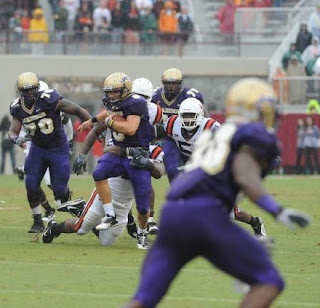
Others are the Ole Miss Rebels home loss to Jacksonville State 49-48 in double overtime, North Dakota State upset at Kansas 6-3, South Dakota trouncing Minnesota 41-38, Gardner-Webb knocking off Akron 38-37 in overtime and Liberty defeating Ball State 27-23. That doesn't including some close calls experienced by Washington State, Purdue and Temple, all who eeked out W's.
Add it up, and after a handful of schools like Alabama's, Oklahoma's and Ohio State's, it's a muddled middle of parity where any school can win on a given Saturday.
And the great equalizer in the college game is television.
Just look at the number of games carried by ESPN on a weekly basis, it's in the dozens, not to mention other cable and network outlets. Prep stars realize if they want to play and move onto the NFL, it can be anywhere, because you'll get five or six games on TV minimum. That phenomenon is starting show in the NFL.
Look back at last NFL Draft results. Sure there were plenty of players from the blue blood schools drafted, especially in the first 10 picks. But two players were taken in the first round from Idaho WAC schools, multiple late-round picks came from I-AA schools like James Madison and a few picks were made from the D-II ranks like Hillsdale and Indiana (Pa.).
After his team's upset, James Madison coach Mickey Matthews said "the dirty little secret is the top six to eight teams at our level (I-AA) can play with anyone." I'm not so sure that's a secret anymore.
Tuesday, September 14, 2010
With sports, it's still crazy
Admiral Ackbar is back!
Unfortunately, it's not because he's going to be named the official mascot at the University of Mississippi. Lucasfilm killed that idea, disallowing the famed Star Wars General's likeness to be seen on a college football sideline near you.
However, ESPN generally knows a good story when they see one and is telling the Ackbar story in commercial form. What's not to love really?
The Ole Miss mascot search continues, and they will probably settle for mascot likeness such as a bulldog, or tiger, or bear, oh my!
Anyway, here's the extended version of ESPN's Ole Miss/ Ackbar commercial (the shorter version first aired during the Boise State-Virginia Tech game):
Tuesday, August 24, 2010
NCAA fearless predictions: Version 2k10
I'm ready for the new season of college football. So ready in fact, I'm a week ahead of myself for when games actually kick-off.
Regardless, we can't turn the page on a new season without some fearless and bold predictions. There's a good chance come January, I won't want to look back at these...
UConn will contend for the Big East title, but will come up just short. Also, don't expect Cincinnati, who lost head coach Brian Kelly to Notre Dame, to fall off the wagon.
Colorado head coach Dan Hawkins (16-33 at CU) might just be coaching intramurals by season's end.
Hawkins failures, compounded with Dirk Koetter's snafu at Arizona State (40-34, 2-19 vs. ranked teams) means current Boise State head coach Chris Peterson will be a Bronco for life, despite a disappointing 10-3 season this year for the Smurf turfers.
The Big 12 won't be staying at 10 teams for long. Great seasons by TCU and Houston will fast track them for membership in the new Texas-centric conference.
Nevada's Colin Kaepernick is probably the quarterback you haven't heard of. You'll know about him by the end of the year.
Florida State QB Christian Ponder will pass himself into the Heisman lead by the beginning of October and won't look back.
What about last year's Heisman winner Mark Ingram? Ingram will have fewer total yards from scrimmage then Alabama backfield partner Trent Richardson.
The Crimson Tide will still win the SEC, but will be considered this year's biggest disappointment. It's all relative, because anything less than a second straight trip to the BCS title game will be considered a failure. I don't see that happening because...
A non-AQ will play for the national championship. Which brings to the rest of my predictions.
Conference Champions:
ACC: Florida State (Atlantic), Virginia Tech (Coastal)
Big 10: Ohio State
Big 12: Oklahoma (South), Nebraska (North)
Big East: Pittsburgh
Pac-10: Oregon
SEC: Alabama (West), Georgia (East)
C-USA: Houston
MAC: No. Illinois
Mt. West: TCU
Sun Belt: Middle Tennessee
WAC: Boise State, Nevada (tie)
BCS Bowl Predictions
ROSE BOWL: Oregon vs. Texas
FIESTA BOWL: Oklahoma vs. Arizona
ORANGE BOWL: Florida State vs. Pitt
SUGAR BOWL: Alabama vs. Miami
TITLE GAME: Ohio State vs. TCU
Subscribe to:
Posts (Atom)