Friday, October 8, 2010

A lost decade on the good ship Mariner

The Mariners could be looking up at the rest of the AL West for years.

In my lifetime, I've had very little to cheer about as a fan of the Pittsburgh Pirates. The last time the Bucs won was 1992 and things ended in bitter fashion.

But I can say with solace it's probably worse to be a fan of the Seattle Mariners.

With a payroll trending in the upper-crust of MLB, Seattle should see the right side of .500 nearly every year. That's been the exception, not the rule. And as things played out this year the M's were the only other team, aside from Pittsburgh, to lose 100 games or more.

It's been a downward spiral at Safeco Field this decade.

In 2001, the Mariners won a record 116 games but failed to make it to the World Series. The next two years Seattle would finish with 93 wins, but miss the playoffs.

Skip ahead to 2008, the M's would earn the dubious distinction of becoming the first team in history to lose 100 games with a $100 million payroll. And by season's end in 2010, Seattle was experiencing its second 101-loss season in the past three years.

Expectations were unrealistically high entering this year. After 85 W's developing an identity as a defensive team in 2009, the Mariners went all in trying to stop runs, adding an aging Chone Figgins and trading for pitcher Cliff Lee. What the team failed to address in the 2010 off-season was its offensive.

Ex-manager Don Wakamatsu told ESPN Magazine he was surprised by the Mariners 24-game turnaround in 2009, because they had the worst offense in the American League. It didn't get any better in 2010.

Seattle had the worst offensive in all of baseball: 30th in batting average, slugging and runs. The team actually scored the fewest runs (513) for any AL team in a full season since the designated hitter arrived.

Some other humorous and dysfunctional moments that derailed the 2010 campaign: the report of Ken Griffey Jr. sleeping the clubhouse during a game, Griffey's abrupt retirement in June and a dugout fight between a slumping Figgins and Wakamatsu in late July.

It's hard to put a finger on exactly why Seattle's slumped in the standings this decade. But you can point one of those big foam fingers at the front office.

They haven't been able to recognize good talent when it's in the farm system (Shin-Soo Choo, Rafael Soriano). And for every big free-agent decision that worked out (like Raul Ibanez), there's three or four that failed miserably (Richie Sexson, Jeff Weaver, Miguel Batista, Carlos Silva).

Maybe their biggest blunder in this lost decade, was a five-for-one trade which sent outfielder Adam Jones and pitchers George Sherrill, Tony Butler, Chris Tillman and Kameron Mickolio to Baltimore for Erik Bedard.

Bedard has only started 30 games in three years for the M's, while Jones has developed into a solid everyday outfielder for the O's and at age 25 is likely just coming into his prime.

Seattle has holes everywhere, especially on the field. With limited financial flexibility and very few promising prospects there is little hope in the near future.

The Seattle Mariners are writing its own history of futility and its possible another lost decade is about to begin in 2011.

The call for MLB replay intensifies

Maybe you missed it, but Tim Lincecum pitched a 14 strikeout, two-hit gem for the San Francisco last night. It started the Giants off on the right track for what they hope will be a meaningful October run.

Using Bill James' Game Score formula, Sports Illustrated's Joe Posnanski says Lincecum's performance was better than Philadelphia pitcher Roy Halladay's no-hitter, just the second postseason no-hitter ever.

But maybe you did miss it, because most of what people have been talking and writing about today are the blown calls by umpires. It's becoming an October sport in its own right.

In the Giants game, catcher Buster Posey was clearly out on replay trying to steal second base in the fourth inning. He ended up scoring the game's only run for San Fran.

In Tampa, first base umpire Jerry Meals missed a check-swing call which gave Texas Ranger Michael Young a chance to keep hitting, which he did. Instead of a strike out, Young smashed a three-run homer to give Texas a commanding five run lead. Rays fans started chanting "replay".

Maybe it would have had an impact, maybe not. We'll never know, since Tampa Bay seems to have forgotten how to hit with just eight in two games in postseason.

And in Minnesota, the Twins had misgivings about balls and strikes too. Same song different verse as New York's Lance Berkman should've been called out on a third strike, and instead struck on the scoreboard with a go-ahead double. Yahoo Sports Jeff Passan wrote home plate umpire Hunter Wendelstedt's strike zone would've been bad for a Little League game.

Calls this year for more instant replay in baseball have been loud ever since June, when Detroit pitcher Armando Galarraga got robbed of a perfect game. In the postseason, so far people seem more focused on bad calls then the great performances.

Call me old school, but I still haven't warmed to the idea of more instant replay.

Back in August, ESPN's Outside the Lines reviewed every call, with the exception of balls and strikes, for two weeks. Of the plays they deemed "close" 20.4 percent were found to be incorrect, 65.7 percent were confirmed as correct and 13.9 percent were too close to call.

That shows even with replay umpires are still needed.

If Major League Baseball decides to expand replay, and unfortunately I think they will, they need to go all in. A lot of the critics calling for more replay argue the objective is to get the call right. The technology exists for electronic balls and strike calls and they should do it, along with fair or foul calls and close plays on the bases.

I think any additions to replay will take the humanity out of the game. Maybe the humanity is already gone, if all people are interested in is their favorite pastime, complaining about the umps.

Wednesday, September 29, 2010

Baseball losses the 'Big Mo' in October

One week into autumn, we're about to turn the page on September, and yet the "Fall Classic" isn't even close to getting underway.

Major League Baseball, unlike its football counterpart, is a marathon not a sprint. But that marathon is finishing well past the point where anyone can remember summer. People aren't tuning in, and aren't getting excited about the pennant races.

SI.com's Tom Verducci wrote at the beginning of the month "for the second straight September, baseball offers the resistance of a lack of pennant races and national narratives." Verducci thinks there are too few teams competing for a just couple playoff spots come September. Why his fix is interesting, adding a second wild card entrant, there's a problem with his premise.

Baseball is taking too long to play its season.

Yes, most of the pennant races get wrapped up in mid-September (or earlier). But when some of the most meaningful games are being played this weekend, most people will be tuned into a slate of giant college football games (Stanford-Oregon, Alabama-Florida, Texas-Oklahoma those are off the top of my head).

The final weekend of baseball in October isn't buzz worthy enough in to keep sports fans collective conscious off pigskin. But if the League Championship Series' were wrapping up or the World Series starting, that would be another story.

August is prime real estate for baseball's pennant races and they need to capitalize on it. Cutting games, say eight, and playing double-headers could achieve this without taking much away from the rest of the season.

A finale coming in the second week of September means baseball could hold more interest and momentum as they play on the field for title, and compete on the screens for fans.

Monday, September 27, 2010

The ALL-American conference

The days of small college athletic conferences seem numbered. The Pac-10 is becoming 12, the Big Ten (which actually has 11 schools) is expanding.

In the age of conference cannibalism the mid-majors should position themselves for survival, and join forces.

Conference USA is vulnerable. It's already been raided once by the Big East. If the major conferences try for mega-expansion, C-USA looks ripe for the picking again.
Out west, the Western Athletic Conference is a dead conference walking. On the verge of a coup, adding BYU in non-football sports, the Mountain West stole Nevada and Fresno State leaving it for dead.

This week the WAC membership committee will hear from the first of several schools looking to move up from I-AA to I-A. That's one option to survive.

Instead of trying to nurture new I-AA schools the WAC should set sail and push full throttle the radical idea of creating a true ALL-American conference, with teams from the Carolina coast to Hawaii and everywhere in between.

An 18-team mid-major conference would be a power player in the college landscape, able to leverage big TV deals and possibly able to negotiate a seat at the BCS table.

Here's how the true C-USA could work. There would be two separate 9-team divisions, basically a split down the Mississippi River.

The "Pacific Division" would include the Texas schools west: Hawaii, San Jose State, Idaho, Utah State, New Mexico State, UTEP, SMU, Rice, Houston.

The "Atlantic Division" would be every school to the east: Tulsa, Louisiana Tech, Tulane, So. Miss, UAB, Memphis, Marshall, East Carolina, UCF.

Do the math and the farthest schools would have to travel out west is probably Houston to Honolulu. In the east, it's Tulsa to Greenville, NC. That true east-west split will help cut down travel costs, something that hurt the first mega-conference, the 16-team WAC.

Each division crowns its own champion through playing eight other schools. Then the only cross-over between east and west would be for the championship game, which could rotate between favorite bowl locations including Hawaii and Orlando.

That intra-division play, would set up a dynamic title game. Much like the rumors swirling now about C-USA and the Mountain West setting up a championship showdown, the true C-USA would pit two of the best mid-majors against each other on that final weekend.

That meaningful championship would give the schools one last shot to impress voters, which matters.

College football is all about big money and the BCS. And a true USA conference would not only survive but could thrive in today's game.

Wednesday, September 15, 2010

Parity reigns supreme on college gridiron

Watch the scores rotate on the bottom of our TV screen this college football season, and they will raise some eyebrows.

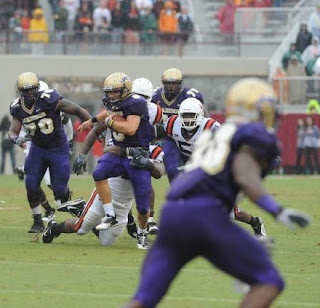
There's a growing list of BCS schools falling victim to lowly I-AA (or FCS) squads. In just two weeks, six I-AA teams have defeated their higher division opponents, none more shocking than James Madison's 21-16 upset over then No. 13 Virgina Tech at Lane Stadium.

Others are the Ole Miss Rebels home loss to Jacksonville State 49-48 in double overtime, North Dakota State upset at Kansas 6-3, South Dakota trouncing Minnesota 41-38, Gardner-Webb knocking off Akron 38-37 in overtime and Liberty defeating Ball State 27-23. That doesn't including some close calls experienced by Washington State, Purdue and Temple, all who eeked out W's.

Add it up, and after a handful of schools like Alabama's, Oklahoma's and Ohio State's, it's a muddled middle of parity where any school can win on a given Saturday.

And the great equalizer in the college game is television.

Just look at the number of games carried by ESPN on a weekly basis, it's in the dozens, not to mention other cable and network outlets. Prep stars realize if they want to play and move onto the NFL, it can be anywhere, because you'll get five or six games on TV minimum. That phenomenon is starting show in the NFL.

Look back at last NFL Draft results. Sure there were plenty of players from the blue blood schools drafted, especially in the first 10 picks. But two players were taken in the first round from Idaho WAC schools, multiple late-round picks came from I-AA schools like James Madison and a few picks were made from the D-II ranks like Hillsdale and Indiana (Pa.).

After his team's upset, James Madison coach Mickey Matthews said "the dirty little secret is the top six to eight teams at our level (I-AA) can play with anyone." I'm not so sure that's a secret anymore.